

Key takeaways
- Multichannel selling across Amazon and eBay increases revenue opportunities while reducing platform risk.
- eBay and Amazon do not directly connect; managing listings and inventory manually across channels creates risk and inefficiency at scale.
- Multichannel sellers often struggle with overselling, time-consuming updates, slow fulfillment, and high labor costs.
- Centralized multichannel listing and inventory software enables synchronized inventory, bulk updates, and scalable growth.
- The cost of eBay and Amazon inventory software ranges from $0 to $2,000 per month, depending on order volume and business complexity.
When selling on eBay and Amazon, growing order volumes eventually lead to operational challenges. Most multichannel sellers struggle with the significant time commitment required to manually sync inventory across channels, not to mention managing listing templates, photos, and product descriptions.
The good news is that you can easily overcome these limitations by using technology. This article provides a roadmap for managing high-volume sales on Amazon and eBay, including ways to overcome common operational challenges with multichannel listing and ecommerce inventory management software.
In this article, we review five eBay and Amazon inventory software solutions that help multichannel sellers synchronize inventory, manage listings, and scale operations across both marketplaces.
Top 5 eBay and Amazon inventory software solutions

1. Descartes Sellercloud™
Sellercloud is a comprehensive ecommerce operations platform designed for high-volume multichannel sellers. It centralizes inventory, listings, orders, purchasing, and warehouse management in one system. Built-in automation, forecasting, and integrations make it ideal for complex operations scaling across marketplaces and fulfillment networks.
- Centralized inventory management keeps stock synchronized across marketplaces, warehouses, and fulfillment methods, helping sellers prevent overselling and maintain accurate stock levels.
- Larger ecommerce businesses benefit from advanced workflow automation, deep integrations, and customizable processes designed for complex multichannel inventory environments.
- Predictive purchasing tools help sellers forecast demand, automate replenishment planning, and maintain optimal stock levels across multiple channels and warehouses.
- The Skustack warehouse management system (WMS) module provides barcode scanning, directed picking, bin tracking, and advanced fulfillment workflows for high-volume operations.
- With hundreds of integrations across marketplaces, carriers, accounting platforms, and logistics providers, the platform supports large ecommerce ecosystems as businesses scale.
2. Descartes Finale™
Finale is a cloud inventory management system designed for growing ecommerce businesses that need better stock visibility across sales channels and warehouses. It provides strong inventory control, barcode scanning, and purchasing tools while remaining easier to implement than enterprise platforms.
- Centralized inventory tracking helps sellers maintain accurate stock levels across ecommerce platforms, warehouses, and retail systems.
- Barcode-based inventory tracking supports faster receiving, picking, and stock counting while reducing manual errors in warehouse operations.
- Purchase order management and reorder point tracking help businesses maintain inventory availability and reduce stockouts as order volume grows.
- Growing sellers can implement advanced inventory management without the complexity typically associated with enterprise ecommerce systems.
- The system connects with popular marketplaces, ecommerce platforms, and accounting software to support multichannel operations from a single inventory platform.
3. Linnworks
Linnworks is a multichannel inventory and order management platform designed to simplify ecommerce operations. It provides centralized inventory control, multi-warehouse tracking, and automation tools, making it suitable for growing sellers. However, dropshipping management and deeper warehouse customization may be limited.
- Synchronizes inventory across connected marketplaces using inventory mapping, ensuring stock changes automatically update listings and orders across channels.
- Supports multiple warehouse locations, enabling sellers to track stock availability and fulfillment activity across different storage locations within one platform.
- Offers demand planning and stock forecasting tools through an optional add-on, helping sellers estimate replenishment timing and prevent stockouts.
- Emphasizes simplified workflows and faster onboarding, making it appealing to ecommerce teams with straightforward operations and limited technical resources.
- Supports kits, bundles, and automation rules but does not provide full dropshipping control.
See how Linnworks compares to Sellercloud.
4. SellerChamp
SellerChamp is a multichannel platform designed for ecommerce sellers in earlier stages of growth that need inventory sync, Fulfillment by Amazon (FBA) support, and dropshipping workflows. It handles core listing and inventory tasks well, but may be less suited for operations that require deeper warehouse management and predictive purchasing.
- Real-time inventory synchronization helps sellers keep stock aligned across marketplaces, reducing overselling risk when managing listings on multiple channels.
- SellerChamp covers core needs like listings, inventory, FBA, and dropshipping without requiring enterprise-level setup.
- Reserve and max-quantity controls can help protect fast-selling items by holding back inventory for specific channels or promotions.
- SellerChamp does not provide many of the warehouse management features offered by more advanced systems, which may be a drawback for sellers with in-house fulfillment complexity.
- Purchasing controls may present challenges for larger businesses with more demanding replenishment needs.
See how SellerChamp compares to Sellercloud.
5. Sellbrite
Sellbrite is a multichannel inventory platform built for ecommerce teams that need listing, inventory, and order management. It handles core inventory synchronization and multi-warehouse tracking well, but does not provide forecasting, advanced reporting, bundle support, or WMS.
- Real-time inventory syncing helps keep stock accurate across marketplaces, reducing overselling risk for sellers managing products on several channels.
- Teams can get core multichannel inventory and listing tools at a low entry price without committing to enterprise-level systems.
- Multiple warehouse locations can be managed inside the platform, which helps sellers track stock across more than one storage location.
- More complex catalog strategies may be harder to manage because bundles, kits, mirrored listings, and multi-category support are not available.
- Inventory visibility is solid, but larger sellers may outgrow the platform because forecasting and advanced profit reporting are not supported.
See how Sellbrite compares to Sellercloud.
Ready to streamline multichannel growth?
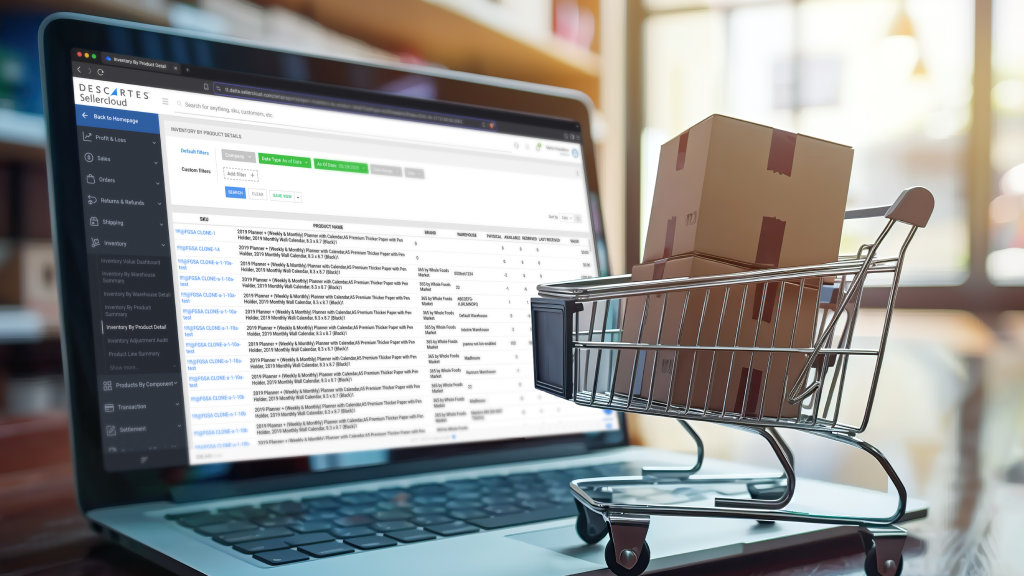
If you are evaluating how to streamline Amazon and eBay operations without adding headcount, it may be time to assess your current systems. A connected ecommerce operations platform like Sellercloud can help you centralize listings, automate inventory synchronization, ensure on-time fulfillment, and scale confidently across channels.
Conquer your eBay and Amazon inventory management challenges today. Book a Sellercloud demo to discover how our solution makes inventory management across channels a breeze.
If you enjoyed this blog post on eBay and Amazon inventory software, you may also benefit from reading the following:
- Can You Sell on Amazon and eBay at the Same Time?
- What’s the Best Inventory Management Software for Amazon?
- What’s the Best Multichannel Listing Software?
- What Are Marketplace Fees? Amazon, eBay, Walmart, & Etsy
eBay and Amazon inventory software FAQs
How much does eBay and Amazon inventory software cost?
Pricing greatly varies based on order volume, number of SKUs, integrations, and feature depth, ranging from $0 to $2,000 USD per month. Small businesses typically start with a free plan and lightweight tools. High-volume businesses averaging 1000+ orders per month require advanced tools for automation, warehouse management, reporting, inventory forecasting, and API integrations.
What is the best eBay and Amazon inventory software?
The best solution depends on your business size, operational complexity, and growth goals. Popular software includes Descartes Sellercloud, Cin7, Linnworks, and Rithum for high-volume operations and Sellbrite for small businesses. Look for software that centralizes listings, syncs inventory in real time, integrates with fulfillment workflows, and provides cross-channel reporting. Scalability, reliability, and marketplace compliance tools are often more important than entry-level pricing.
How long does it take to implement multichannel inventory software?
Implementation timelines depend on catalog size, data quality, and integration requirements. Small catalogs may be onboarded in weeks, while high-SKU or complex operations may take longer. A structured onboarding process that includes catalog mapping, integration setup, and workflow configuration is critical for long-term success.
What features should I look for in eBay and Amazon inventory software?
Key features include real-time inventory synchronization, centralized catalog management, bulk listing updates, dynamic image hosting, order routing automation, and reporting across marketplaces. Advanced sellers may also require warehouse management capabilities, inventory forecasting tools, and accounting integrations.
What are the main benefits of using inventory software for Amazon and eBay?
The primary benefits include reduced overselling risk, faster listing updates, improved operational accuracy, better margin visibility, and scalable growth without adding headcount. Centralized control allows sellers to expand across channels while maintaining consistent data and performance standards.
The information presented on this website, including all product comparisons, is provided for informational purposes only. While we strive to ensure the accuracy and timeliness of the information, all comparisons between our product and those of competitors are based on publicly available data and/or our own internal assessments. We do not represent or warrant that the information related to third-party products is complete, current, or free from error. All product names and company names are the property of their respective owners and are used solely for the purpose of comparison. No endorsement or affiliation is implied. Product features, performance, and pricing may vary over time or by region. Users are encouraged to verify any information directly with the relevant third-party source before making any purchasing decisions. This website does not intend to misrepresent, disparage, or make false claims about any third-party products or services. If you believe any information presented is inaccurate or unfair, please feel free to reach out to us so we can address your concerns.
Related Posts