
Key Points
- Warehouse performance directly affects your profit margins and customer satisfaction.
- Benchmarking and tracking key warehouse metrics and key performance indicators (KPIs) are the first steps toward improvement.
- The 2025 Descartes Warehouse Benchmark Report provides real-world data to help you compare and improve performance.
- Technology like Descartes Sellercloud’s Skustack warehouse management system (WMS) drives measurable gains in efficiency and accuracy.
Warehouse performance plays a central role in ecommerce profitability. Every second saved in picking, packing, and shipping translates to faster fulfillment, lower labor costs, and happier customers. But before you can improve performance, you need to measure it.
In this article, we explore how to improve warehouse performance through measurable benchmarks, industry data, and practical steps that help ecommerce teams boost efficiency.
What Is ‘Warehouse Performance’?
Warehouse performance refers to how effectively a warehouse uses its staff, space and layout, and systems to fulfill orders accurately and on time.
As ecommerce grows and customer expectations rise, optimization has become non-negotiable. Delays or inefficiencies that once went unnoticed can now damage brand reputation and profitability. Leading brands know this and continuously measure and refine their operations to stay ahead.
How to Measure Warehouse Performance?
You can’t improve what you don’t measure. Tracking warehouse KPIs provides visibility into where time, labor, or inventory is being lost. It helps identify inefficiencies before they impact your customers. Common warehouse KPIs include:
- Order accuracy rate.
- Picking productivity (e.g., orders or lines picked per hour).
- Dock-to-stock cycle time.
- Space utilization rate.
- On-time shipment rate.
Benchmarking these KPIs against industry standards reveals how your warehouse compares to top performers.

If you’re unsure how your warehouse stacks up, download the 2025 Warehouse Benchmark Report to access real-world data from leading ecommerce operations. The guide helps you:
- Compare your KPIs to industry averages.
- Identify improvement opportunities across key warehouse functions.
- Learn which technologies top performers use to stay competitive.
- Discover how optimization impacts overall business growth.
How to Measure Picking Productivity?
Picking is often the most labor-intensive and costly process in the warehouse. Tracking picks per labor hour and accuracy per picker shows how well your team performs. Top-performing operations follow best practices like:
- Adopting barcode and mobile scanning to reduce errors.
- Grouping orders by zones/regions or batches to cut travel time.
- Prioritizing orders by urgency.
- Training staff to follow efficient pick paths.
- Using WMS-driven picklists, such as those generated in Skustack, to automate workflows.
For more insight into how WMS technology supports picking productivity, read our article: OMS and WMS: Which Do I Need for My Ecommerce Business?
How to Calculate Warehouse Efficiency?
Warehouse efficiency measures how closely your actual output aligns with your expected performance or capacity. A simple calculation is:
Warehouse Efficiency (%) = (Actual Output ÷ Standard Output) × 100
Modern warehouse management systems and order management systems (OMS) make tracking and analyzing these numbers easier than ever. Many businesses are surprised to find that once they start measuring, they uncover both inefficiencies and previously unnoticed strengths.
Why Benchmarking Matters
Benchmarking is essential because it turns warehouse performance from guesswork into measurable progress. By comparing your metrics to industry standards, you gain clarity on what ‘good’ looks like, and what’s holding you back.
Without benchmarks, it’s difficult to know whether low picking rates or long dock-to-stock times are genuine issues or simply part of normal variance. Benchmarks highlight these gaps, helping you set realistic improvement goals that align with your resources and operational constraints.
They also create accountability across teams. When warehouse staff understand performance expectations based on objective data, it becomes easier to track progress, reward improvements, and sustain momentum.
Ultimately, benchmarking helps transform performance data into action, showing you where to focus your time and investment to achieve measurable efficiency gains.
How Does Descartes Sellercloud Help Improve Warehouse Performance?
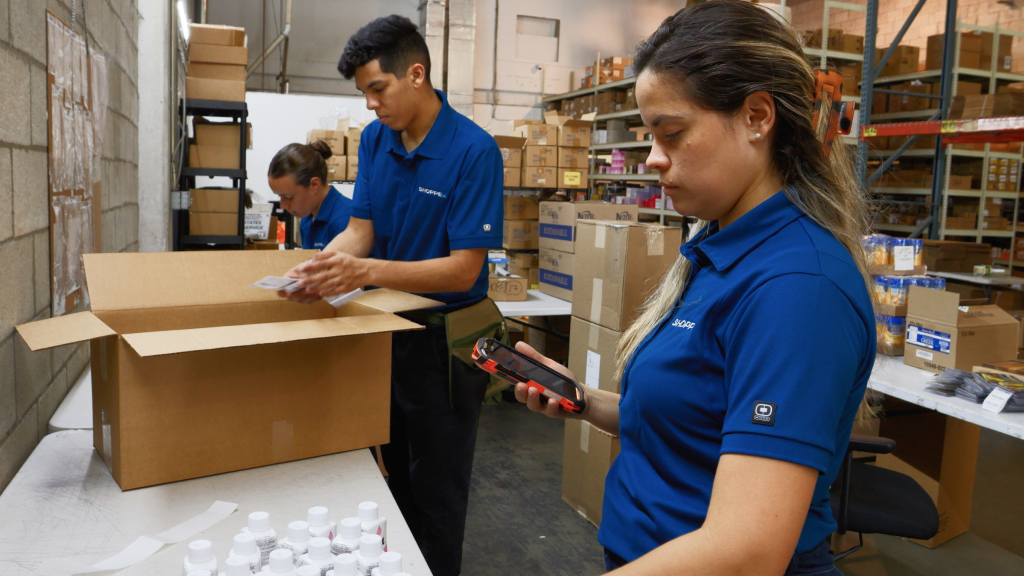
Descartes Sellercloud is a multichannel ecommerce operations platform that centralizes your order, inventory, warehouse, and shipping management into one system. It helps businesses simplify complex workflows, eliminate manual bottlenecks, and gain full visibility across every sales channel and fulfillment center.
Descartes Sellercloud’s Skustack WMS module gives ecommerce sellers the tools to manage, measure, and improve warehouse performance from a single platform. Key features include:
- Real-time inventory and warehouse visibility across all locations.
- Bin-level tracking for precise inventory management.
- Mobile scanning to eliminate manual errors.
- Measurable increases in picking speed and order accuracy.
- Built-in tools to monitor employee performance.
Together, these features empower sellers to uncover performance gaps and act on them quickly.
The video below demonstrates how real businesses have improved warehouse performance using Descartes Sellercloud and its Skustack WMS module.
Book a Descartes Sellercloud demo today to discover how our solutions can improve your warehouse performance. For direct-to-consumer (D2C) brands, Descartes Peoplevox offers a purpose-built WMS designed for scalability and speed.
Related Posts